
Think of the last training program you completed. The content was probably well-structured. The facilitator was engaging. You left the session feeling informed, maybe even energized. And then, when you went back to work with the intent to use what you had learned.
That moment, right there, is where most learning quietly falls apart.
Not because the training was bad. But because knowing something and being able to do something are two very different things. And the gap between them is almost entirely left to the individual to navigate alone.
This is the central challenge of workplace learning and learning transfer today, and it has a name: the 70% gap.
The 70-20-10 Learning Model: Where Workplace Learning Really Happens
In the L&D world, the 70-20-10 model is a key concept that describes where the actual growth comes from.
According to this model, 70% of the growth happens from experiential learning, 20% from social learning like training, coaching sessions, etc., and only 10% from theoretical learning like workshops, modules, assessments, etc. 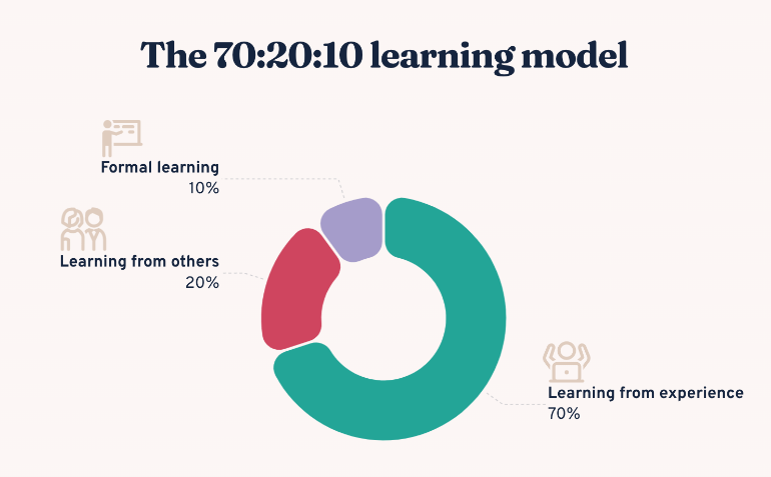
From this, we can infer that a major chunk of learning and growth happens from actual application of our knowledge, while the efforts that we put in assignments, coaching sessions, and content libraries are a small piece of the learning pie chart. But usually, the learners are expected to go out and simply apply what they have learned in the real world.
Why Learning Breaks Down in the Real World
The reality is that the real world is spontaneous, and it does not wait for your prepared script of answers. The situations tend to arrive without a warning sign, and they leave no room for error.
A manager who just completed a workshop on difficult conversations still has to sit across from a team member and find the words in real time. A new leader trained in giving feedback still feels their chest tighten before that first honest conversation. The workshops, the discussions, the roleplay exercises in a room full of colleagues, they all matter. But they only take you to the edge. What happens next, in the actual moment, with an actual person, has always been left entirely to the individual.
However, the L&D space has long been struggling to come up with a cost-effective and consistent way of providing learners with a safe space to practice their skills.
How AI Is Changing Learning and Development
L&D has long hopped on the AI trend with content curations, adaptive learning, automated assessments, and much more. However, certain new advancements in the AI space are coming out that would sit well in the 70% gap.
AI-powered roleplays and simulations provide learners with a safe environment to practice the high-stakes skills taught in L&D before applying them in real workplace situations. They are making it possible for the learners to practice realistic scenarios with AI avatars, have back-and-forth conversations, and get real-time responses.
The differentiating factor for this developmental tool is that the responses are not predefined. Rather, the learners can have dynamic conversations with the avatars and see where the conversations go, practicing multiple times, with a different set of tones, responses, skill sets, etc., to get that confidence.
AI simulations and roleplays are already being used across industries to support experiential learning, leadership development, communication skills training, and workplace performance improvement. One key upside of this advancement is the real-time feedback analysis. The emergence of AI simulations is helping organizations make the invisible 70% visible, strengthening the connection between learning, practice, and workplace performance.
AI Simulations as an Extension of Human Learning
AI roleplays are not a replacement for the human bit in learning, rather an extension to it. The 20% of the learning that includes coaching sessions, training, relational learning, etc., still remains very much relevant. AI roleplay is like a virtual assistant or facilitator that is available at all times and indeed multiple times for the learners.
And yet, the most significant shift AI brings to L&D is not in how we deliver learning. It is where we finally allow it to happen.
The 70% Gap Has Always Lived in the Workplace
The 70% was never lost from the workplaces. It was always there, sitting in the spaces between meetings, in the awkward silence after a difficult conversation, in the moment a manager freezes before giving feedback that they know needs to be said. We handed it over to the workplace and hoped people would figure it out. We relied on real mistakes, real consequences, and real people on the other side to do the teaching.
And here is the uncomfortable truth: learning is messy. It always has been. But when the mess happens in front of real people, with real stakes, many learners do not push through it. They become conscious, they hold back, they play it safe, and quietly, they give up. The very environment meant to develop them becomes the reason they stop trying.
That is the gap that no content library or coaching session ever fully closes.
How AI Roleplays and Simulations Close the 70% Gap
AI roleplays and simulations do not make learning clean. But for the first time, they give every learner the dignity to fall without that fall costing someone else. To try, to fail, to reflect, and to walk back in, without leaving a mark on a real relationship or a real moment that cannot be undone. The messiness of learning remains, but the consequences of that mess no longer have to be carried by others.
That is not a small thing. That is everything!