
Picture this: It’s Monday morning. You’ve barely settled into your chair when a text from your manager lights up your phone “Can we talk today?”, with no context and no clue.
Now picture a different scene: midweek, you’re deep in work when an email lands in your inbox. Your annual performance review is sitting there waiting to be opened, the one that shapes your increment, your promotion, and your career trajectory.
Which one throws you off more?
The first situation is loaded with ambiguity. For some, it sparks curiosity, a “let’s see what this is about” moment. For others, it hijacks the entire day before a single word of context is offered. The second situation may carry far greater consequences and yet may cause far less disruption, or far more, depending entirely on the emotional state you happened to walk in with that morning.
This raises a question worth sitting with: why does the same situation feel entirely manageable on some days, and completely unbearable on others?
THE WINDOW OF TOLERANCE
The window of tolerance is that emotional zone where you have full control over your emotions, and you think, feel, and respond effectively. Coined by Dr. Daniel Siegel, “Window of Tolerance” is the optimal zone of arousal where you function most effectively.
However, at times, stress and trauma in personal life or workplace situations can narrow down your window of tolerance. This dysregulation can push you into two zones:
- Hyperarousal: This is where your body is in fight or flight mode. Excessive energy gets activated in your body, making you overly responsive and causing anxiety, fear, and panic.
- Hypoarousal: This occurs when your body completely shuts down as a trauma response. It can cause numbness, zone-outs, and lack of energy.
Ideally, you want to be in your window of tolerance to sail through smoothly. But varying triggers and situations can lead you into different zones of emotional arousal. This is a universal emotional response, and not a personal flaw.
THE WINDOW AND THE WORKPLACE
The Workplace is one of the most consistent environments where our nervous system shows up every single day. Deadlines, feedback conversations, shifting priorities, and interpersonal dynamics are a part of workplaces; none of these are inherently harmful. They are simply the natural texture of professional life, and they engage our nervous system constantly, whether we are aware of it or not.
When operating within our window of tolerance, these same pressures can work for us, like a tight deadline can sharpen focus, challenging conversations can deepen a working relationship, and uncertainty about a project can spark creative thinking.
This is why the Window of Tolerance is such a useful lens for the workplace. It simply helps us understand what is happening inside us, and why the same Monday morning can feel energizing one week and unbearable the next.
RECOGNIZING YOUR ZONE
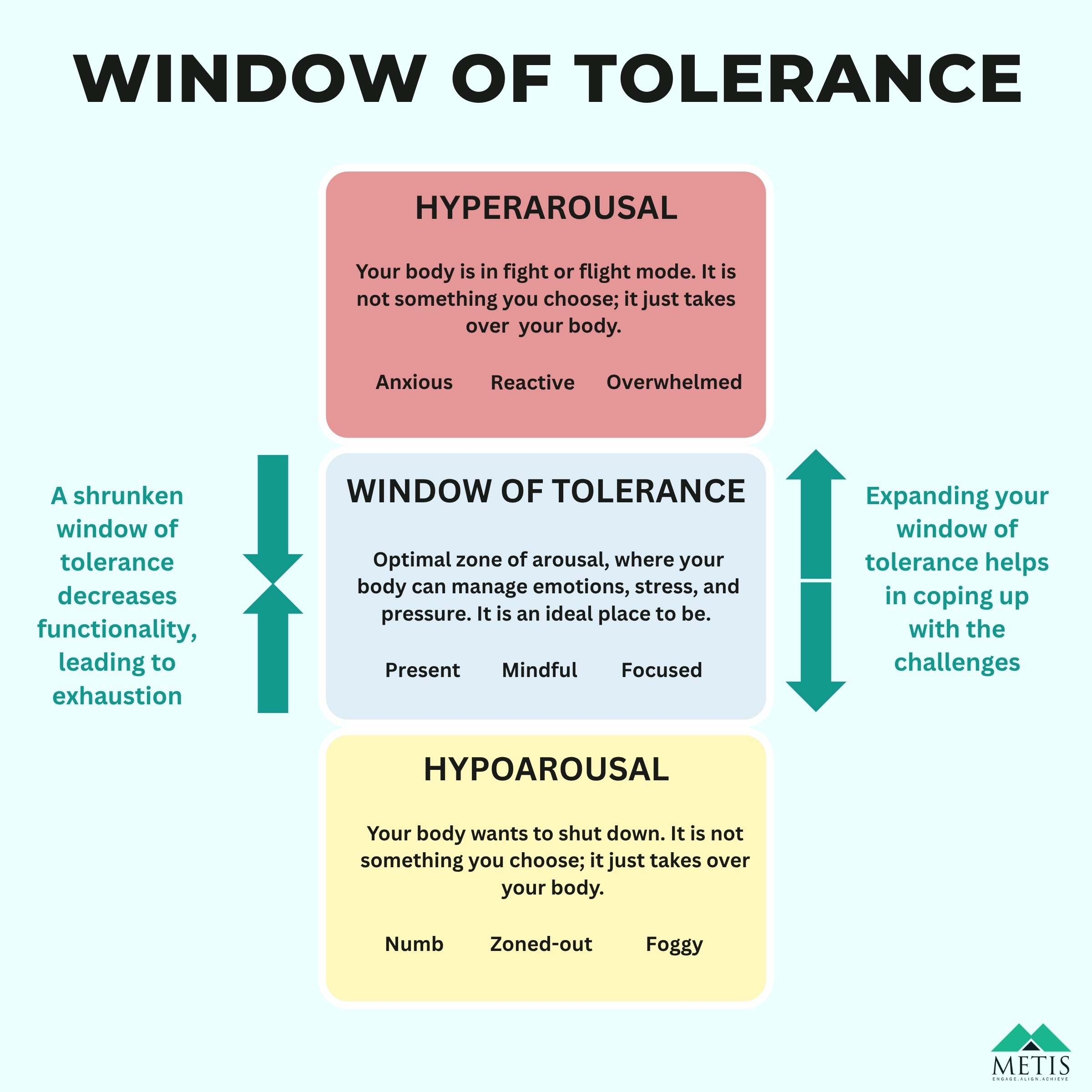
We move between the three zones multiple times a day, and this is true for everyone. Maintaining balance begins with awareness, knowing where you are in the window at any given moment. It is only after recognising your zone of emotional arousal that you can begin to self-regulate.
Here are some day-to-day signs that can help you identify where you are:
- Hyperarousal: snapping at your colleagues, racing thoughts, over-explaining, tensed body
- Window of tolerance: present, focused, collaborative, productive, able to sit with ambiguity
- Hypoarousal: zoning out in meetings, procrastinating, emotional flatness
WIDENING YOUR WINDOW
Awareness is a good starting point, but only when it leads you somewhere. There are simple ways to move back to your window of tolerance, without overhauling your entire day.

On a personal level, you can:
- Practice some breathwork to calm down your nervous system
- Take short walks in between meetings or step out briefly, to discharge tension
- Engage in sensory grounding by gentle movement and noticing things around you, to bring back presence
- Name and claim your feelings to reduce the intensity
To conclude, your nervous system is not weak; it is doing exactly what it was designed to do. The Window of Tolerance does not ask you to become someone who is always calm and composed. It simply offers an understanding of why some days you are fully present and others you are barely holding it together, and why both of those experiences make complete sense.
Work will always carry pressure, and difficult conversations will still happen. But there is a meaningful difference between pressure that moves through you and pressure that accumulates in you, and that difference often comes down to awareness.
So, the next time a Monday feels impossible for no obvious reason, or you snap at someone and immediately wonder why, pause before the self-criticism. You may simply be outside your window. And that is not a conclusion. It is a starting point.