
 According to leading researchers, humans tend to initiate new things after temporal landmarks, which explains why we often set a list of goals to achieve on the first of every year.
Goal setting spikes our dopamine, which feels great initially, but it fades as quickly as it builds. That’s why you must have experienced that this list of goals is usually forgotten or overlooked by the beginning of February.
Therefore, to fulfil our goals, we need to support them with a system that focuses on small and consistent improvement. Such systems are rooted in habits that form our daily behaviour and set the tone for achieving our goals by automating our actions in the long term.
Goals Need A Support System
Goals feel comfortable and relatable because they are clear and intentional. Driven by a sense of purpose, they make our lives appear sorted. But goals stay in the future. They rely on willpower and constant motivation, which is the most unreliable source of fueling progress.
Goals do not define the path that needs to be followed to achieve success, and that is the phase where our goals fade.
Systems Support Goals
“You don’t rise to the level of your goals, you fall to the level of your systems.” – James Clear (Atomic Habits)
In the hustle and bustle of our daily lives, we often rearrange our priorities and unintentionally drift away from our goals. We do not lack ambition, but the strong backing of a system to support our goals. These systems are our defaults, or what we refer to as our habits.
Our habits, as tiny and unimportant as they may seem, are the building blocks of our identity. They shape the kind of person we want to become. By structuring us behaviourally, they pave the way for us to achieve our goals.
Top 5 Ways To Build Habits That Sustain
We have understood how important habits are for us to achieve our goals, but building them such that they endure is a very intentional step. Let us look at some of the well-crafted and proven strategies of building habits that sustain:
1. The Goldilocks Rule
Remember Goldilocks, from the fairytale, who chose the porridge, the chair, and the bed that was neither too big, nor too small, but just right for her.
The same rule applies here to habit building, where you pick habits that are neither too hard, to cause you fatigue, nor too easy, to bore you in the long term, but just right to keep you in the state of flow and at the edge of your abilities.
To get in the “just right” zone, start small with easy-to-do habits and gradually build on to difficult ones. This will keep you engaged in the process and ensure linear growth with time.
2. Habit Stacking
About 40-45% of what we do every day is a habit. Habit stacking is a way of building new habits by attaching them to the already existing ones. By doing this, you create neural pathways and give way to adopt new habits. This method helps you create an obvious cue (trigger) for any new habit and set it in motion.
For example, after I brush my teeth, I will meditate for 10 minutes.
3. Keystone Habits
Keystone habits are small habits that have a ripple effect on our behaviour, thus transforming our other habits. As stated by Charles Duhigg in his book The Power of Habit, “keystone habits help establish cultures where change becomes contagious”.
For example, a person who starts exercising daily, begins to eat healthy, builds a sleep schedule, reduces screen time, and becomes more productive at work.
4. Identity-Based Habits
The moment we tie an action to our identity, it gets rooted in our personality and sustains in the long term. Considered as the deepest layer of behaviour change, in James Clear’s Onion Framework, change in identity shifts our inherent beliefs and assumptions.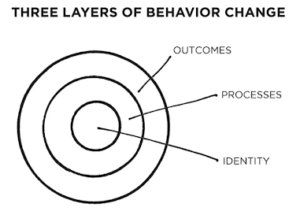
For example, to become an avid reader (outcome), you have to become someone who reads without missing a day (identity), for which you will have to start reading 10 pages daily (process).
5. Micro Habits
Pick up on small doable actions that you can repeat daily without much effort. This will help you build momentum and set the tone for achieving big goals. Progress may seem stalled at first, but the effects of your daily actions will reap compounded benefits in the long term.
To begin with this, you can follow the 2-minute principle, where you pick a habit in under 2 minutes. For example, doing 5 push-ups every day to build a habit of exercising daily.
To conclude, goals give us a direction, but systems, built on habits, determine the path to be followed in that direction. What shapes our output is not what we aspire to achieve, but what we consistently do without negotiation to achieve it. When habits are designed thoughtfully, growth becomes the default.
Therefore, instead of relying on bursts of motivation, we must focus on building the defaults that will carry us forward, even on days when our discipline runs low.
Before you close this tab, pick one two-minute habit. Start small, almost laughably so, like writing one sentence, reading two pages, and drinking a glass of water, and promise to repeat it daily. Growth will follow your consistent efforts quietly, but relentlessly.